
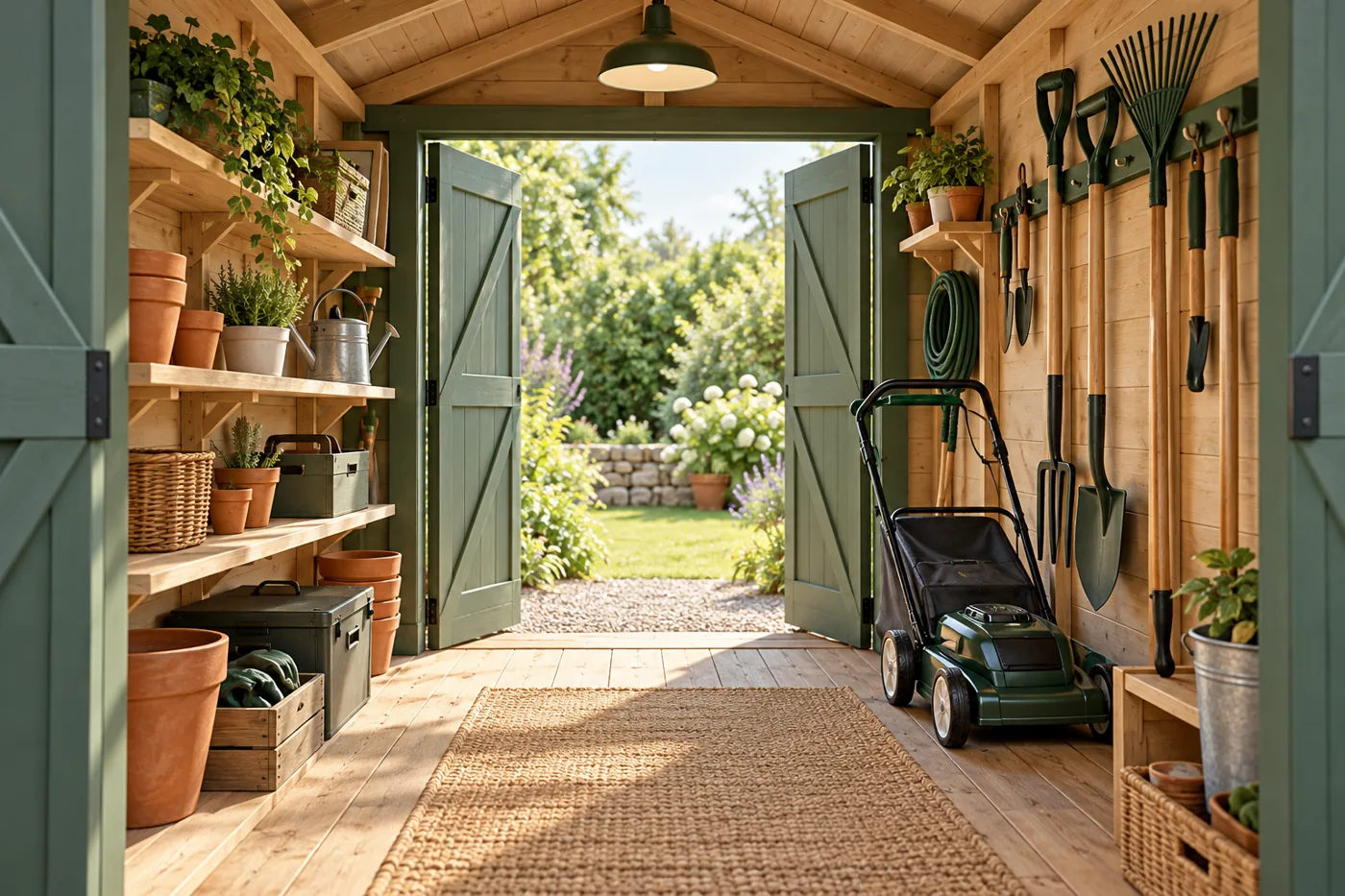
Organize an 8×10 shed around the item you retrieve most often. Give that item a direct route to the door, place bulky equipment before shelves, and treat empty access space as part of the storage plan.
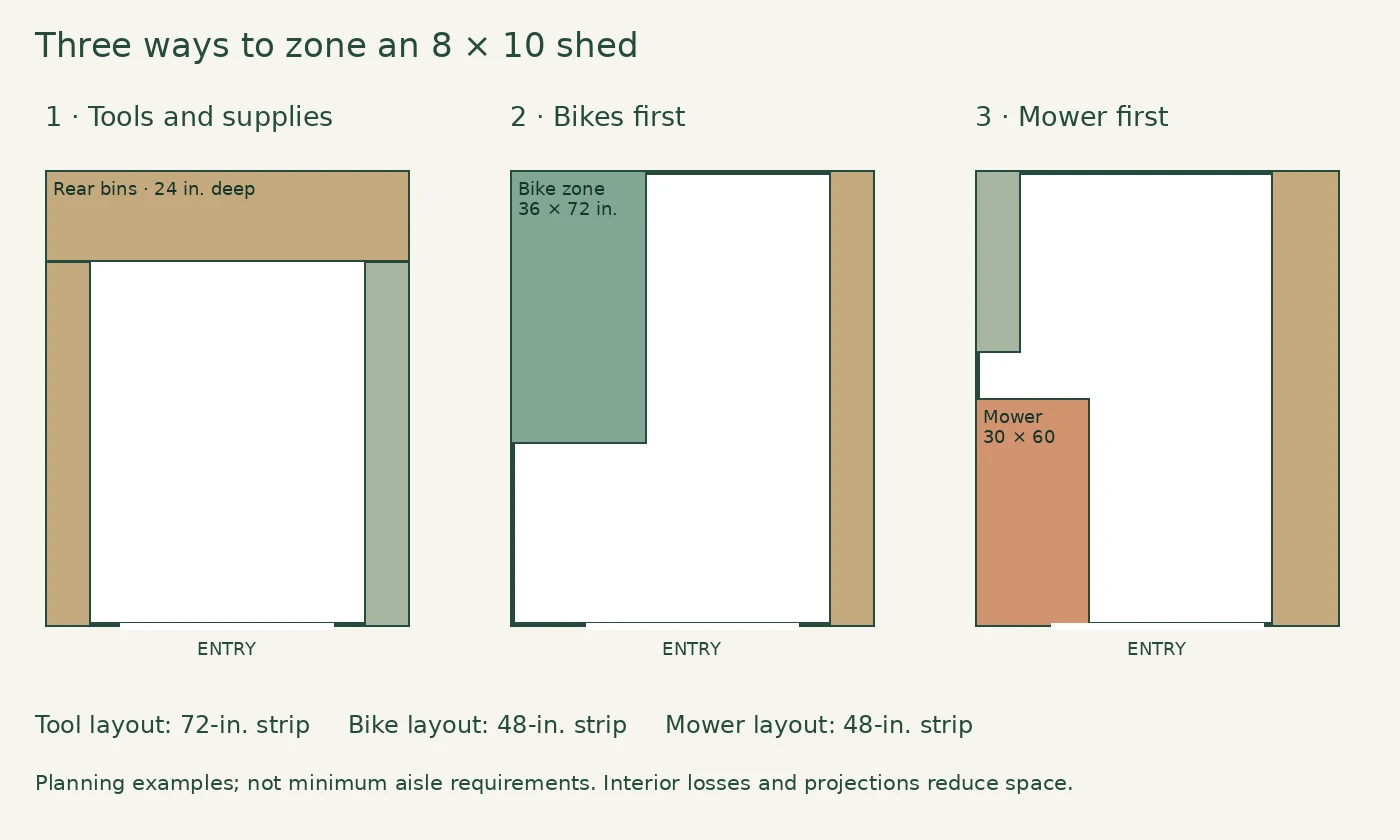
The three layouts below use an illustrative 96-by-120-inch rectangle with a centered door on the 96-inch front wall. Actual interiors are often smaller. These arrangements are planning concepts, not construction drawings or guaranteed fits.
Start with a measured inventory
Empty the shed in dry weather. Sort contents into weekly, seasonal, and rarely used groups. Remove duplicates and items that belong elsewhere. Measure each large object in its stored configuration and in its retrieval configuration: folded mower handles may save space but require room to unfold; bike handlebars may be wider than a wheel rack.
Mark the real interior, door opening, and door swing on a driveway. Use cardboard or tape for shelves. Try each layout without buying organizers first.
Layout 1: Garden tools and small supplies
Put shallow, 12-inch-deep shelves on the left wall and a compatible tool rack on the right. Reserve the rear wall for a 24-inch-deep freestanding unit holding larger bins. Keep frequently used hand tools near the entrance and seasonal supplies at the rear.
| Zone | Example footprint | Use |
|---|---|---|
| Left shelves | 12 in. deep | Small labeled bins |
| Right tool zone | Allow 12 in. projection | Rakes, shovel, broom |
| Rear shelving | 24 in. deep | Bulk storage low down |
| Central strip | 72 in. before other projections | Open access |
The 72-inch figure is 96 minus 12 minus 12. It ignores wall losses, rack hardware, and handles angled into the aisle. Test the largest tool’s removal motion and leave space to lift it from its holder.
Layout 2: Two regularly used bicycles
Place the bike zone along one side from front toward rear, with handlebars staggered if that genuinely helps. Keep shallow shelves on the opposite wall. Avoid installing shelves directly over the bike parking zone if they make you duck or interfere with lifting a bike.
A 36-inch-deep bike zone opposite 12-inch shelves leaves a 48-inch strip in our example rectangle. That does not mean all bicycles fit in a 36-inch zone. Measure your own bikes, racks, and handlebars. Give the most-used bike the position closest to the door. If the rear bike cannot leave without removing the front one, either accept that tradeoff explicitly or change the arrangement.
Layout 3: Mower first, storage around it
Park the mower near the door along one side. Put an 18-inch-deep shelf run on the opposite side and narrow hand-tool storage toward the rear. An example 30-inch mower envelope opposite an 18-inch shelf leaves a 48-inch central strip. Keep the mower’s exit route straight; do not store buckets at the threshold.
Let equipment cool before storage and follow its owner’s manual for fuel, batteries, and seasonal maintenance. Never run an engine inside a shed. Do not make a compact layout depend on stepping over the mower or lifting it past shelves.
Make the layout work with your shed material
For wood framing, suitable racks still need proper fasteners and attachment to appropriate structural members. For resin and thin metal walls, do not assume ordinary wall hooks are acceptable. Use model-compatible accessories or freestanding units. Lifetime’s shelf accessory listing identifies compatible shed models; compatibility is a real design constraint.
A 20-minute reset routine
- Label shelf zones by job: lawn, garden, bikes, seasonal.
- Store heavy containers low and keep lids accessible.
- Mark the mower and bike parking footprints.
- Keep one clearly defined return point for small tools.
- After two weeks, move frequently retrieved items closer to the entrance.
A successful layout lets you remove one everyday item without dismantling the rest. If every arrangement fails that test, reduce the inventory or reconsider shed size.
Source: Lifetime: 3-Piece Shelf Accessory Kit compatibility. Reviewed October 9, 2026. All layout dimensions are illustrative.
Continue planning
- 8×10 vs. 10×12 Shed: Which Size Fits Your Storage Needs?
- Small Shed Shelving: Freestanding vs. Wall-Mounted Options
- How to Store Bikes in a Small Shed Without Blocking the Door
- How to Store Long-Handled Garden Tools in a Small Shed
Image: AI-generated concept illustration; not a measured layout or product photograph.