
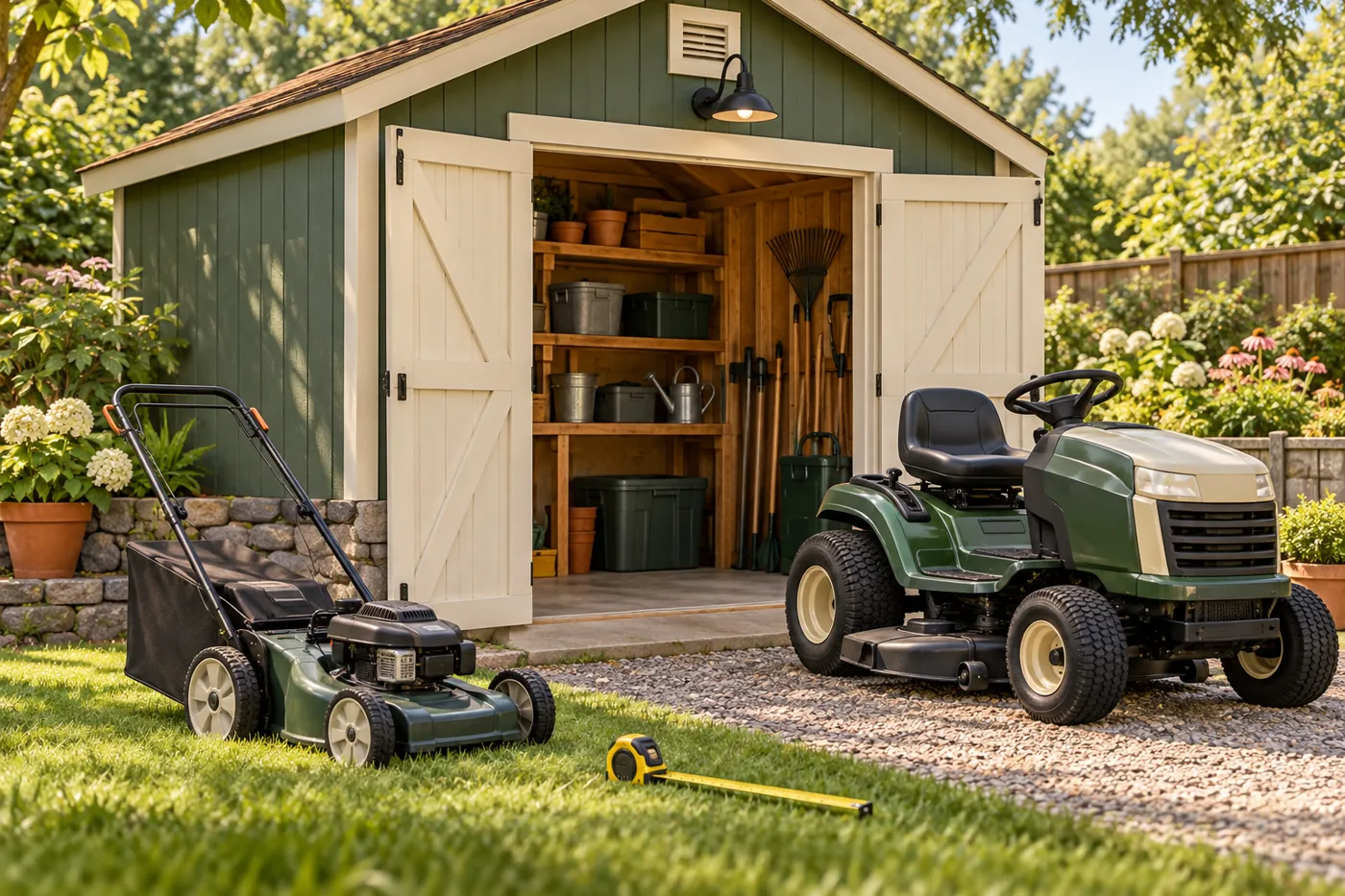
The right shed size for a lawn mower depends on its full stored envelope, the clear doorway, and the route needed to move it. A mower’s cutting width is not its storage width. Measure the actual machine before comparing shed labels.
Measure a push mower in two configurations
With the mower off, cool, and secured according to its manual, measure maximum width including wheels, discharge components, and bag attachments. Measure length with the handle in the normal operating position, then repeat with the handle folded only if the manufacturer allows that storage configuration. Record maximum height.
If folding the handle requires tools or several steps, do not design your daily storage around a folded measurement you will rarely use. Include the grass bag where you actually intend to keep it. Decide whether you can park nose-first and pull straight out without turning inside.
Measure a riding mower differently
Include the deck, discharge chute in its permitted position, bagger, rear attachments, and any rollover structure. Record operating height as well as parked height. Verify the shed floor, foundation, ramp, and threshold can accommodate the machine’s weight and intended use. A nominally wide door says nothing about the floor’s load capacity.
Test the approach outside the shed. A narrow gate, tight corner, slope, or low branch can make a large shed inaccessible. Measure the narrowest point along the entire route.
Turn measurements into a planning envelope
| Measurement | What to record | Why it matters |
|---|---|---|
| Machine width | Widest permitted storage configuration | Clear opening and side clearance |
| Machine length | Handle or attachments included | Parking depth |
| Height | Highest fixed component | Door header and roof braces |
| Weight | Manufacturer specification plus attachments | Floor and ramp suitability |
| Retrieval route | Straight path or actual turning test | Usable access space |
For illustration, a push mower measuring 26 by 58 inches occupies about 10.5 square feet as a tight rectangle. A 36-by-70-inch marked parking zone occupies 17.5 square feet and allows some handling space. That extra space is a planning choice, not a universal minimum. Try it with your machine and adjust.
For a hypothetical riding mower 54 inches wide and 76 inches long, an opening merely equal to 54 inches is an uncomfortable target. Allow practical room for steering and projections; ask the shed supplier for the actual clear opening and suitable ramp options. Do not substitute this example for the mower’s manual.
Test shelves at the same time
A mower can fit in an otherwise empty shed and fail once shelves are installed. In an illustrative 8-foot-wide interior, 18-inch shelving on one side and a 36-inch mower zone on the other leave 42 inches between them. Interior wall losses reduce that figure. Tape every storage zone, then perform the entry and exit movement.
Reserve room for fuel or battery storage only where the equipment instructions allow it. Temperature limits, ventilation, and ignition-source separation depend on the product. Never operate a mower, generator, or other combustion engine inside.
Compare candidate sheds
- Get interior floor dimensions, clear door width, and door height.
- Check threshold and approach height, ramp rating, and weather exposure.
- Check documented floor capacity and required foundation.
- Lay out mower plus all remaining inventory at actual dimensions.
- Confirm you can retrieve the mower without moving stored bins.
Lifetime’s guidance notes that a shed’s integrated polyethylene floor requires support below it. Use the exact model manual, especially for heavy equipment; do not assume every resin floor or timber platform supports a riding mower.
Choose a larger footprint when the extra width solves access or leaves a separate equipment lane. Choose a smaller one only after the loaded layout passes the same test.
Source: Lifetime foundation guidance, reviewed October 9, 2026. Equipment dimensions above are hypothetical planning examples.
Continue planning
- 8×10 vs. 10×12 Shed: Which Size Fits Your Storage Needs?
- How to Organize an 8×10 Shed: Three Practical Layouts
- Gravel vs. Concrete Shed Foundations: How to Choose
Image: AI-generated concept illustration; not a measured layout or product photograph.