
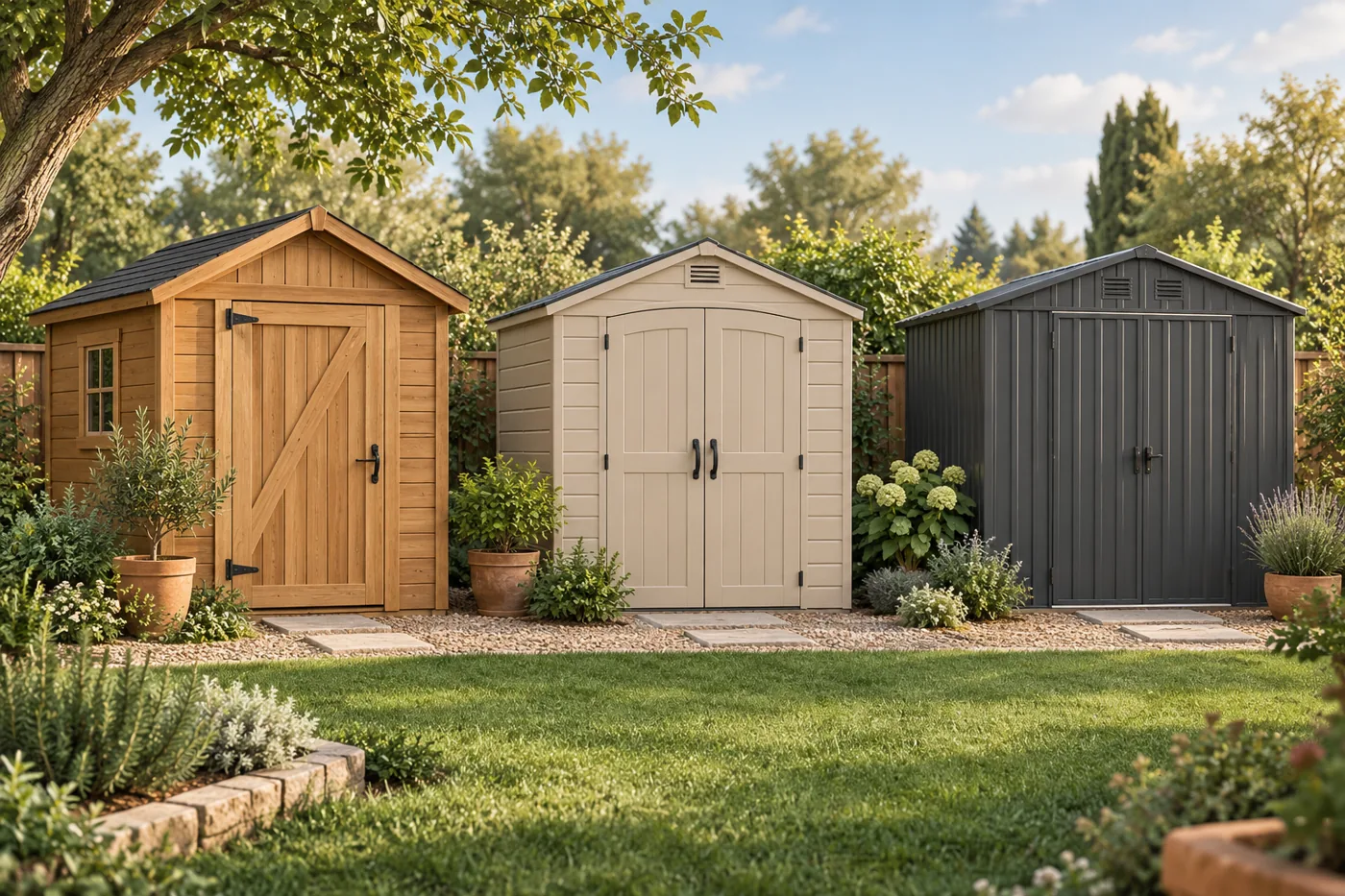
Choose shed material by the maintenance you will actually perform and the storage changes you expect to make. Wood often offers more flexibility for interior modifications. Resin can reduce painting chores but requires model-compatible attachments. Metal can suit straightforward storage, with careful attention to coatings, anchoring, and moisture.
Material alone does not establish durability, security, wind resistance, or load capacity. Compare the exact model’s construction, doors, warranty, and local suitability.
Compare practical ownership tasks
| Question | Wood | Resin | Metal |
|---|---|---|---|
| Exterior upkeep | Inspect finish, joints, roof, and ground clearance | Clean as instructed; inspect panels and joints | Inspect coating, scratches, fasteners, and corrosion |
| Adding shelves | Suitable framing may allow custom systems | Use approved mounting points or freestanding units | Thin panels usually need approved supports |
| Appearance changes | Often more finishing options | Painting or cutting may be restricted | Coating changes require compatible preparation |
| Moisture priorities | Prevent persistent dampness and deterioration | Control leaks, ground moisture, and stored wet items | Watch for condensation as well as leaks |
| Foundation | Match design and local site needs | Included floor still needs specified support | Base and floor may be separate purchases |
Wood: flexibility comes with upkeep
A framed wood shed can be attractive when you need a tool wall, a work surface, or custom shelving. That does not make every wall safe for heavy loads. Locate appropriate structural members and use a mounting design suitable for the load.
Inspect the exterior finish and roof routinely. Pay attention to splashback, soil contact, vegetation, and water collecting around the base. A larger overhang or nicer paint color does not correct a wet site. Ask what is included: floor, roofing, paint, installation, and anchoring may be separate.
Resin: check the system, not just the panels
Resin sheds use different panel designs and reinforcement systems. Their low-maintenance appearance can be appealing, but accessories and modifications are often model-specific. Check the current manual before drilling, painting, or attaching anything.
For example, Suncast’s foundation guidance specifies a wood-frame or concrete foundation for its sheds, and Lifetime publishes model compatibility for a shelf kit. These examples show why an included floor and a material label are not enough information.
Confirm interior measurements and door opening. A shed marketed as 8×10 may not provide an 8-by-10-foot clear storage rectangle.
Metal: simple storage with details to inspect
Check panel thickness or construction description, frame reinforcement, roof design, door hardware, coating instructions, and whether the floor is included. Avoid assuming all metal sheds share the same strength or corrosion resistance.
Condensation can form when humid air contacts a colder roof or wall. Look for ground moisture, wet equipment, ventilation, and possible leaks before buying a moisture-control product. Any lining or insulation change must be compatible with the shed and the local climate.
Four checks that matter for every material
- Site: drainage, allowed footprint, assembly space, and access.
- Storage: real interior dimensions, door opening, and floor capacity.
- Installation: foundation, anchoring, weather conditions, and labor.
- Ownership: cleaning, finish repairs, replacement parts, and warranty exclusions.
For a homeowner who expects custom shelves and routine exterior maintenance, wood may be the better match. For standard storage and limited customization, an appropriately specified resin model can be convenient. For a straightforward storage enclosure, a suitable metal model may work well if the site and moisture plan are sound.
Ask for a complete specification
Request the assembly manual before purchasing. Compare roof-load and wind information for your location, accessory compatibility, and total installed cost. Avoid choosing by price per nominal square foot alone; losing access space or buying a separate floor can reverse that comparison.
Sources: Suncast Foundation FAQs and Lifetime shelf-kit compatibility. Reviewed October 9, 2026. This is a material-selection guide, not a tested product ranking.
Continue planning
- Small Shed Shelving: Freestanding vs. Wall-Mounted Options
- Does a Resin Shed Need a Foundation? What to Check Before Installation
- Why Is My Metal Shed Wet Inside? Condensation vs. Leaks
- How to Budget for an 8×10 Shed: Costs Beyond the Shed Itself
Image: AI-generated concept illustration; not a measured layout or product photograph.